In most political theories and ideologies, there is a preposterous oversimplification about what kinds of political relationships are desirable, common, or even possible. Given the irreduceable complexity of society, any summary of real-world political relationships is by necessity going to be greatly oversimplified, but most such movements neglect even very broad and common kinds of political relationships. So herein, based on my extensive study of the legal relationships between political players that have existed in a very wide variety of polities, is a classification scheme:
Let's define a "polity" as any entity with some coercive powers. Polities can range in scale from the United Nations to the jail cell at the back of your local shopping mall. By studying polities over many years, and borrowing from previous work on law and political science, I have identified three basic kinds of legal relationships between polities. The basic legal structure, or constitution, of a polity can also be characterized by how much and in what ways it is composed of each kind of relationship. The three basic kinds of political relationships are:
(1) Delegation: This includes any kind of delegation from a principal to an agent. The principal authorizes the agent to act for him, e.g. by making a contract or treaty with a third party to which the principal will be bound. A principal can be a boss, a contractee, or voter; the corresponding agents being employee, contractor, or representative. We can characterize principal/agent relationships by representation distance, with each extreme common:
(A) at a very short representation distance is the master/servant (in modern parlance, employer/employee) relationship. The master gives orders to the servant who is delegated to carry them out and closely supervised. A military dictatorship, for example the Roman Empire, is or was dominated by commander-subordinate relationships. In such a system, to paraphrase the legal code compiled for the Emperor Justinian, the emperor's will is law.
(B) at the other extreme, an extremely long representation distance, is the relationship between millions of voters and the representatives they vote for in most modern governments. Voters do not give orders, but rather are treated as having delegated most their coercive powers to their representatives. Representatives in modern governments usually further delegate political and legal power to unelected bureaucracies themselves dominated by type A (boss/employee) relationships.
(2) Subsidiarity: for example the relationship in the United States between counties and states, or between the states and the federal government. Often these combine supremacy clauses (when in conflict the law of the encompassing jurisdiction trumps that of its subsidiaries) with typically enumerated powers (the subject matters of the encompassing power is typically limited relative to that of the subsidiary). We can characterize subsidiarity relationships by how much and what kinds of coercive power can be exercised by the encompassing jurisdiction.
In medieval England, the subject matter of the encompassing jurisdiction was very small, the Crown essentially having jurisdiction only regarding procedural laws for interactions between subsidiarity jurisdictions (which like the encompassing Crown were held as property by individuals or corporations), as well as some war-making powers. Substantive law was almost entirely in the hands of the encompassed jurisdictions, including the specialized merchant courts as peers enforced an international standard of business law, the lex mercatoria.
By contrast in the modern U.S., the substantive legal jurisdiction of the encompassing power has become vast in scope. Nevertheless one can still find many examples of fine-grained subsidiarity, down to "stand your ground" laws, citizen's arrest, and those shopping mall jail cells.
In property law (which once was also procedural law and essential to defining political relationships), the landlord/tenant relationship is a subsidiarity relationship. The landlord is generally not the master of the tenant, and cannot issue the tenant arbitrary commands, but rather their relationship is governed on both sides by the constraints imposed by the tenancy.
(3) Peer-to-peer: these include any agreements made between polities where neither is a subsidiary of the other, or a standard law arrived at in parallel, either through parallel development of precedent (as in the lex mercatoria and many other bodies of law) or codification of a standard law (e.g. the Uniform Commercial Code, which is not federal or national law, but a standard set of laws separately enacted by 50 separate jurisdictions, the states of the United States, as peers). Peer-to-peer relationships most commonly involve maintaining distinct sets of laws adapted to local conditions along with agreements or mutually evolved practices for resolving conflicts of laws. Conflict-of-laws law itself was primarily developed through parallel development of judicial precedent, through courts respecting each other in order to maintain their reputations for enforcing the rule of law. On a larger scale wars and treaties between nations are peer-to-peer relationships. In medieval Italy, a wide variety city-states that were often at war with each other nevertheless also developed through this process most of the body of modern conflict-of-laws law.
Since political theory developed in universities out of the study of Roman imperial law, it has been dominated by imputing to polities only one of the above kinds of relationships -- namely master/servant or commander/subordinate relationships, or at best delegation in general. This is especially apparent in the quixotic search for a "locus of sovereignty", a search that typically amounts to conspiracy theory in search of a hidden commander-of-all when in fact far more sophisticated combinations of the above kinds of relationships are at play.
For further reading:
Conflict-of-laws law
Substantive vs. procedural law
Jurisdiction as property (subsidiarity and peer-to-peer relationships via property law)
Representation distance
Liberty of house (common law origins of stand-your-ground laws)
Friday, March 29, 2019


Nibbles & Kiwi

Rascal was really thriving due to our training. He had grown much stronger from our first encounter in the fields beyond Pallet. His progress filled me with confidence. West of Viridian City in the foothills of the Indigo Plateau, we encountered an aggressive, little Nidoran. As absurd as it may seem, I think the Nidoran was weaker than Rascal when Professor Oak and I first caught him. He was puny and feeble, but he made up for it in sheer enthusiasm. I named that little fellow Nibbles and we began training as soon as he was rested. Nibbles was always eager to train and never shied from a challenge.
Now, I do recall the Pokédex made the distinction that Nibbles was male. I remember clearly because I pondered this several times throughout my journey in Kanto. Pokémon gender at the time was nothing more than hypothetical conjecture. There was no definitive study on the subject, and Professor Oak's Pokédex entry on the Nidoran species compiled by me and other contemporary Pallet Town trainers would spark a more conclusive investigation in the near future. I used the computer in the Viridian Pokémon Center to email Professor Oak several times about Nibble and the Pokédex entry. He requested I find a female variant of the species, but in all my searching of Kanto that year, I was never able to capture one. The closest I came to a female Nidoran was in trainer battles which collected a good amount of data, but unfortunately not as much as I'd be collecting on Pokémon directly in my care.

Training Nibbles was a lot of work. In those early days, he was pretty useless in a battle. We relied heavily on Rascal to teach him how to handle himself and get him ready for competitive battling in the future. Some days we were out in the south training against wild Rattata and Pidgey. On other days we made our way into the shadow of Indigo Plateau to the west and were fighting Rattata and other Nidoran. Eventually, Nibble's aggressive and enthusiastic nature paid off and he was able to protect me from all the wild Pokémon we encountered. He was ready, but unfortunately the gym was still closed. So we ventured to the north side of Viridian City for the first time to see what we could find, capture and study there.
On Route 2, Nibbles pinned down a Pidgey which I expertly captured. Kiwi was a welcome addition to the team. Kiwi was the strongest wild Pokémon we'd subdued so far, possibly stronger than both Rascal and Nibbles combined when I first met them. This made him a lot easier to train. He was able to steadily hold his own against wild Pokémon right away. The four of us continued to train around Viridian City until my two weeks worth of paid lodging expired. At that point, it was time to move on. There were no trainers to fight in Viridian City and I had given up on the gym reopening in time to rescue me from my financial crisis. I would have to take the team north through the forest to Pewter City and hope the competitive Pokémon scene was better.
I packed my meager supplies into my backpack and headed out the north gate. I would have been well on my way down Route 2 toward the Viridian Forest, except I had happened to overhear a conversation between two children. They noticed the Pokéballs holstered to my backpack and began excitedly chatting. They found it coincidental that I happened to be leaving just as a new trainer was arriving. I casually approached the children, trying to pretend I wasn't eavesdropping, but soon was crouched down beside them. With wide and eager eyes and perhaps a hint of desperation in my tone, I asked them where I could find this new trainer in town.
They began jumping up and down in excitement, asking if we were going to battle. Laughing, I told them it would be up to the other trainer, but I was hoping to challenge him. The next thing I remember, all three of us were rushing through the city streets toward Route 22. My heart was pumping at the thought of my first trainer battle. My finances were completely forgotten, too. My brain was a complete blur. The only thing I could think about was the challenge and the thrill. Despite building and training my team for two weeks, I really wasn't prepared for what we would find on the road to Indigo Plateau.
Current Team:
Attacks in Blue are recently learned.
Wednesday, March 27, 2019
Dragon Ball FighterZ Free Download
Dragon Ball FighterZ Free Download
Dragon Ball FighterZ Free Download PC Game setup in single direct link for Windows. It is an amazing action game.
Dragon Ball FighterZ PC Game 2018 Overview
Coming back to the roots of the DRAGON BALL Z series, Goku is now ready to unleash his fearsome techniques, born from the combination of Saiyan DNA and earthling martial arts!

Features of Dragon Ball FighterZ
Following are the main features of Dragon Ball FighterZ that you will be able to experience after the first install on your Operating System.

- Goku as a new playable character
- 5 alternative colors for his outfit
- Goku Lobby Avatar
- Goku Z Stamp
- Got high resolution textures.
- Got awesome visuals.
System Requirements of Dragon Ball FighterZ
Before you start Dragon Ball FighterZ Free Download make sure your PC meets minimum system requirements.

- Tested on Windows 7 64-Bit
- Operating System: Windows Vista/7/8/8.1/10
- CPU: AMD FX-4350, 4.2 GHz / Intel Core i5-3470, 3.20 GHz
- RAM: 4GB
- Setup Size: 2.4GB
- Hard Disk Space: 6GB
Dragon Ball FighterZ Free Download
Click on the below button to start Dragon Ball FighterZ. It is full and complete game. Just download and start playing it. We have provided direct link full setup of the game.
Size: 2.4 GB
Price:Free
Virus status: scanned by Avast security
Fallout 4 (Bethesda, 2015)

Fallout 4 was released one year ago - and even if this wasn't the case it seems appropriate to talk about a video game that depicts the apocalyptic breakdown of America in the weeks surrounding the election of Donald Trump.
This game has eaten up more of my time than any other this generation and it's far from perfect, but like any other Bethesda RPG its difficult to put the controller down because there is always one more hideout to clear out, one more quest to complete, one more piece of armor to craft or one more secret to discover. So I thought I'd talk about the different reasons why I think Fallout 4 is S.P.E.C.I.A.L.
1. The Setting
This separates Fallout from other run of the mill works of post apocalyptic fiction - its futuristic yet retro universe injects 1950s post war culture into the year 2077. In this alternative reality, the world is utilising atomic energy to create advanced technology like domestic robots and micro computers. Of course, this all goes wrong when different powers begin to fight over the soon strained resources. The juxtaposition between the modern and the nostalgic gives the games a really distinct and unique feel, so you can walk around listening to Billie Holiday while shooting bandits with a high powered lazer gun.
White picket fences, the fear of the red menace and the conformity of society - where everyone's homes look identical is part of the series' criticism of the American Dream. Everyone has a television, fridge and robot butler during peacetime. It's an interesting parallel, that many Americans during the 1950s were scared of appearing anything other than normal for fear of prosecution over communist sympathizing. Even in a world ravaged by nuclear war there is still witch hunts over suspected individuals known as 'Synths' - robotic humanoids that look and act like normal beings but are being hunted down because of the fear that they are going to replace humans. This similarity may have been completely unintentional, but it's hard not to be reminded of Invasion of the Body Snatchers (Sigel, 1956), a film famously seen as an allegory for the Cold War era, where inhabitants of a small town are replaced by emotionless imposers.
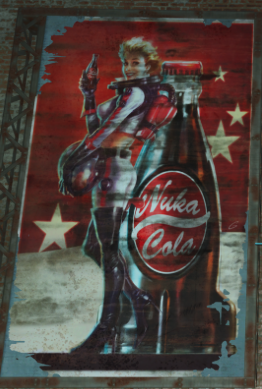
Remnants of the world before the bombs dropped still remain, and do a great job of telling a story without words - the consumerist society of the 50s and 60s Mad Men era is clear to see. Advertising posters and other merchandise for Nuka Cola, the game's fictional soft drink are littered all around - so much so that in the post apocalyptic world the new currency is now the caps from these bottles.
It takes a funny, deadpan approach to the issue of nuclear war too, with Protect and Survive style public service announcements acting as tutorials whilst the game is booting up - advising the commonwealth inhabitants how to survive in their new, post - apocalyptic world:
"Following total atomic annihilation the rebuilding of this great nation of us may fall to you"
Unlike Skyrim, the combat is very satisfying. Skyrim largely consisted of button mashing with your sword (with your eyes closed if you were fighting those giant spiders, in my case) and involved little to no skill, especially in comparison to other, more recent fantasy RPGs such as The Witcher 3 which implemented a dodge and roll button. However, in this, each gun feels different, distinct and you'll have to master and get used to the recoil of every one. Furthermore, you'll have to make every bullet count - it's no good just spraying bullets everywhere, because ammunition is extremely limited if you don't upgrade the appropriate luck perk, which adds a real sense of desperation to the combat. The V.A.T.S targeting system, which allows players to target specific limbs of their enemies now only slows down time, when in previous games it would freeze it completely, again this adds to the tension since you're no longer invincible when picking your targets.

Added to all of this, human enemy AI is very impressive. They'll take cover effectively even in derelict buildings where the infrastructure is demolished, and for the most part will practice self preservation by healing themselves after taking a few hits. You'll learn during gameplay that the superhuman enemies that you face all have different weaknesses, and the appropriate weapon will have to be used to ensure maximum effectiveness. Given the setting, you'll have to battle the effects of fallout, and when you enter a contaminated area your total health will drop, so you'll have to keep your eye your character's well being more than usual.
To be honest, much of it is pretty much a carbon copy of Fallout 3, and this has always been a criticism against Bethesda games. They found a formula that worked and are somewhat reluctant to deviate from it. There also an odd disconnect between the main storyline (a search for your missing son) and the story you make yourself (pissing about shooting super mutants and finding the best looking armour ) - because of course you're free to ignore main missions and shun your duties as a parent looking for their newborn. But is this not the case with every sandbox? I think if a massive game such as this had players who weren't getting distracted, that would be an an even bigger worry. It's just a testament to how fun Fallout 4 is to play that this happens, and although some have criticised it for rarely deviating from a game where you just shoot everything you see, there is actually a quite large amount of diversity in it. You may also find yourself voluntarily switching up your playing style depending on the companion that you have following you at any given time. For example, whilst one companion with admire you for acting in a reckless and remorseless way, another will hate you for it - and this makes you change your approach to many dialogue and combat options that are presented to you.
3. Crafting To be honest, much of it is pretty much a carbon copy of Fallout 3, and this has always been a criticism against Bethesda games. They found a formula that worked and are somewhat reluctant to deviate from it. There also an odd disconnect between the main storyline (a search for your missing son) and the story you make yourself (pissing about shooting super mutants and finding the best looking armour ) - because of course you're free to ignore main missions and shun your duties as a parent looking for their newborn. But is this not the case with every sandbox? I think if a massive game such as this had players who weren't getting distracted, that would be an an even bigger worry. It's just a testament to how fun Fallout 4 is to play that this happens, and although some have criticised it for rarely deviating from a game where you just shoot everything you see, there is actually a quite large amount of diversity in it. You may also find yourself voluntarily switching up your playing style depending on the companion that you have following you at any given time. For example, whilst one companion with admire you for acting in a reckless and remorseless way, another will hate you for it - and this makes you change your approach to many dialogue and combat options that are presented to you.
All those items lying around in Fallout 3 that you could pick up but do nothing with other than sell? They helped to immerse you in the world sure, because it meant that everything was interactive - but they achieved little more than this. Now literally everything you pick up, from duct tape to an old broken camera can be utilised and scrapped into materials for settlements, armour or guns.

After liberating a location such as a farm, you'll have to grow and maintain it, overseeing new settlers who are looking for a safe place to sleep and grow crops. This soon becomes a time consuming and addictive mini game in itself, building important facilities such as water purifiers, generators, beds and makeshift buildings is integral to getting your community to both grow and stay happy. Soon you'll have several different pieces of land on your map, and setting them up to trade supplies with each other will ensure that you'll have enough materials to grow and grow. Because you have to scavenge materials for these essential items through exploration, it doesn't feel like some unnecessary add on that is divorced from the rest of the game, but instead an integral part of it.
This scavenging also feeds into the weapon upgrading - pretty standard stuff. You can make rifles automatic, more powerful, stealthy and also increase the ammo capacity. And hey - if you can't be bothered with all of this and would rather use all the junk you've collected as a weapon, then Fallout 4 still has you covered:
4. Exploration
Soaking in the wold that Bethesda have created feeds you curiosity - it's impossible to simply get on with a given quest without straying off the beaten path to investigate an abandoned subway station or an old shack. Jim Sterling once said, in his review of Skyrim that playing a new Bethesda game is like preparing to die, because once that disk goes in the user may have well departed from this mortal world - these games steal so much time from you it could rightfully be considered "criminal". Likewise, Fallout 4 it quite literally impossible to complete, and completing every main, faction and side quest will take weeks... and this is if you choose to follow a linear path without getting distracted, which we all know is impossible. Yes, it's quite possible to have a tremendous amount of fun just through random encounters in the wasteland.

Occasionally you'll stumble across radio towers throughout the environment, and once you've activated it the player can receive various different transmissions. Some of these will be pre-recorded distress signals sent by stricken 'survivors' who are trapped in their basements or shelters and are desperate to make contact. What makes these encounters memorable is the human aspect, it may be a husband hoping in vain that the rest of his family may come across the signal, or a woman who got trapped in the safe of a jewelry store on the day that the bombs dropped - all of them are terrified and hoping to make contact with another friendly face. You're left to find these locations on your own, there is no map marker or compass - instead the player is left to find the location by the landmark clues given on the radio, or by determining the distance by paying attention to the strength of the signal. These moments were a nice surprise, and its much more satisfying to find encounters like this by chance rather than following a quest marker. Although you'll get a trunk full of loot at the end of it, the real treat is actually the road you take to find these bunkers, and the way they contribute to the world building with their well-told, self contain stories.
Like Skyrim these games are full of lore that is waiting to be discovered, environmental storytelling is great because it leaves the audience to fill in the gaps, so you can wonder in to the remains of a family home and imagine what happened to the inhabitants before the war. Besides this there are computer terminal entries and holotapes, and you'll be left to collect the breadcrumbs and piece together information if you want to find out the story behind it. All of this exploration is held together by an excellent ambient music score that's a real treat to listen to - my favourite track is here:
5. DLC
Bethesda aren't saints when it comes to DLC - we all remember the Oblivion horse armor fiasco. They're still slightly guilty of it this time around too - settlement building is giving them an excuse to give away somewhat lazy downloadable content in the form of simple town building items that seems greedy given the generosity of other developers like CD Project Red - who have been putting out armor, hairstyles, missions and new game modes entirely for their customers, free of charge.

Nonetheless, Bethesda have been doing the odd free bit of DLC with items such as furniture, but since release I've been enjoying the two biggest expansion packs - Far Harbor and Nuka World. Both of these give players new, large areas to explore along with plenty of new missions that are dictated by the player. Far Harbour, for instance sees the player character investigating the case of a missing girl on an gloomy, foggy island where several factions are battling against each other - the aforementioned synths, the local townspeople and a group of deranged cultists known as the Children of Atom. Each one of these factions has their own starkly contrasting beliefs, with more and more intrigue revealed as you begin to gain the trust of each one, when you'll ultimately have to decide whether to reach a peaceful and diplomatic solution or a destructive one. This expansion was a chance for Bethesda to make the charisma perk more effective than it was in the main game - enabling you to make important decisions by talking with other NPC's rather than simply setting guns ablaze - and although like i've mentioned the combat is great fun, this still a welcome change.
Nuka World is by far the most colorful DLC, and since it's set in a theme part it's certainly the most creative in terms of its environment. Those players that are sick of being the good guy all the time now have the chance to take their anger out on those innocent settlers. You can choose to take up allegiance with one of the three gangs that have taken hold over Nuka World - an amusement park based on the popular drink, or you can simply kill everyone and free the locals that have been taken captive. If you choose the former, the commonwealth will become your playground as you become the leader of your chosen gang, pushing out settlers from their land and taking it over as your own. But the real star of the show is the theme park itself - split up into sections including a Galactic Zone, Kiddie Kingdom, Safari Adventure, a Nuka Cola bottling plant and a wild west shanty town. It may not be a particularly groundbreaking setting, Left 4 Dead had a theme park map yet it didn't have as many distinct areas. Story-wise it doesn't have as much going on for it as Far Harbour - it's simply about clearing out areas of enemies and choosing your allegiance to a particular raider gang, but despite this I still had great fun with it.
Introducing AdSense Auto Ads
Finding the time to create great content for your users is an essential part of growing your publishing business. Today we are introducing AdSense Auto ads, a powerful new way to place ads on your site. Auto ads use machine learning to make smart placement and monetization decisions on your behalf, saving you time. Place one piece of code just once to all of your pages, and let Google take care of the rest.
Some of the benefits of Auto ads include:
How do Auto ads work?


Auto ads will now start working for you by analyzing your pages, finding potential ad placements, and showing new ads when they're likely to perform well and provide a good user experience.
And if you want to have different formats on different pages you can use the new Advanced URL settings feature (e.g. you can choose to place In-feed ads on exampleurl.com/games but not on exampleurl.com/sports).
Getting started with AdSense Auto ads
Auto ads can work equally well on new sites and on those already showing ads.
Have you manually placed ads on your page? There's no need to remove them if you don't want to. Auto ads will take into account all existing Google ads on your pages.
Already using Anchor or Vignette ads? Auto ads include Anchor and Vignette ads and many more additional formats such as Text and display, In-feed, and Matched content. Note that all users that used Page-level ads are automatically migrated over to Auto ads without any need to add code to their pages again.
To get started with AdSense Auto ads:
We'd love to hear what you think about Auto ads in the comments section below this post.
Posted by:
Tom Long, AdSense Engineering Manager
Violetta Kalathaki, AdSense Product Manager


Some of the benefits of Auto ads include:
- Optimization: Using machine learning, Auto ads show ads only when they are likely to perform well and provide a good user experience.
- Revenue opportunities: Auto ads will identify any available ad space and place new ads there, potentially increasing your revenue.
- Easy to use: With Auto ads you only need to place the ad code on your pages once. When you're ready to use new features and ad formats, simply turn them on and off with the flick of a switch -- there's no need to change the code again.
How do Auto ads work?

Select the ad formats you want to show on your pages by switching them on with a simple toggle

Place the Auto ads code on your pages
Auto ads will now start working for you by analyzing your pages, finding potential ad placements, and showing new ads when they're likely to perform well and provide a good user experience.
And if you want to have different formats on different pages you can use the new Advanced URL settings feature (e.g. you can choose to place In-feed ads on exampleurl.com/games but not on exampleurl.com/sports).
Getting started with AdSense Auto ads
Auto ads can work equally well on new sites and on those already showing ads.
Have you manually placed ads on your page? There's no need to remove them if you don't want to. Auto ads will take into account all existing Google ads on your pages.
Already using Anchor or Vignette ads? Auto ads include Anchor and Vignette ads and many more additional formats such as Text and display, In-feed, and Matched content. Note that all users that used Page-level ads are automatically migrated over to Auto ads without any need to add code to their pages again.
To get started with AdSense Auto ads:
- Sign in to your AdSense account.
- In the left navigation panel, visit My ads and select Get Started.
- On the "Choose your global settings" page, select the ad formats that you'd like to show and click Save.
- On the next page, click Copy code.
- Paste the ad code between the < head > and </ head > tags of each page where you want to show Auto ads.
- Auto ads will start to appear on your pages in about 10-20 minutes.
We'd love to hear what you think about Auto ads in the comments section below this post.
Posted by:
Tom Long, AdSense Engineering Manager
Violetta Kalathaki, AdSense Product Manager
Surfmonkey, Final Fantasy Tcg, Pokemon Tcg, And Buddyfight!!
Pokemon Mania continues in our household as many games of the TCG and TCG Online are happening.


SurfMonkey and I got together for the monthly game session. This time I conned...convinced him into getting into a fast-paced and cool Bushiroad game called Future Card Buddyfight. The game with the dumb name and great gameplay. We also broke out the Final Fantasy TCG. Expect to see more of those games in the future.


SurfMonkey and his Son of SurfMonkey will be over Saturday for a playdate. Expect an update. Until then, shuffle the cards and chuck the dice.
Sunday, March 24, 2019
ouo.io - Make short links and earn the biggest money

Shrink and Share
Signup for an account in just 2 minutes. Once you've completed your registration just start creating short URLs and sharing the links with your family and friends.
You'll be paid for any views outside of your account.

Save you time and effort
ouo.io have a simple and convenient user interface, and a variety of utilities.
We also provides full mobile supports, you can even shorten the URL and view the stats on a mobile device.

Subscribe to:
Posts (Atom)